.png?width=768&height=403&name=Hubspot%20blog%20image%20banner%20(1).png "The Texas Instruments AM6 Family")
A PHYTEC System-on-Module Comparison
A practical guide to PHYTEC's Texas Instruments AM6 SOM portfolio and the question that actually matters: what processor is best for your project?
Workload map
A quick visual guide to the role each PHYTEC SOM plays in the portfolio.
|
LOW POWER AND COST phyFLEX®-AM62L |
BALANCED LINUX AND HMI phyCORE®-AM62x |
GRAPHICS AND MULTIMEDIA phyCORE® / phyFLEX®-AM62P |
|
CAMERA AND EDGE AI phyCORE®-AM62A |
INDUSTRIAL CONTROL phyCORE®-AM64x |
HIGH-PERFORMANCE VISION phyCORE®-AM67x |
Legacy note: PHYTEC previously supported the AM65x as well, but this guide focuses on the current PHYTEC AM6 portfolio for new designs.
The AM62 family
PHYTEC's AM62 SOMs span low-power Linux, balanced general-purpose computing, advanced HMI and multimedia, and camera-centric edge AI. The right choice depends on how much processing, graphics, display, and vision capability the product actually needs.
Low-power module for connected devices, displays, and general-purpose applications
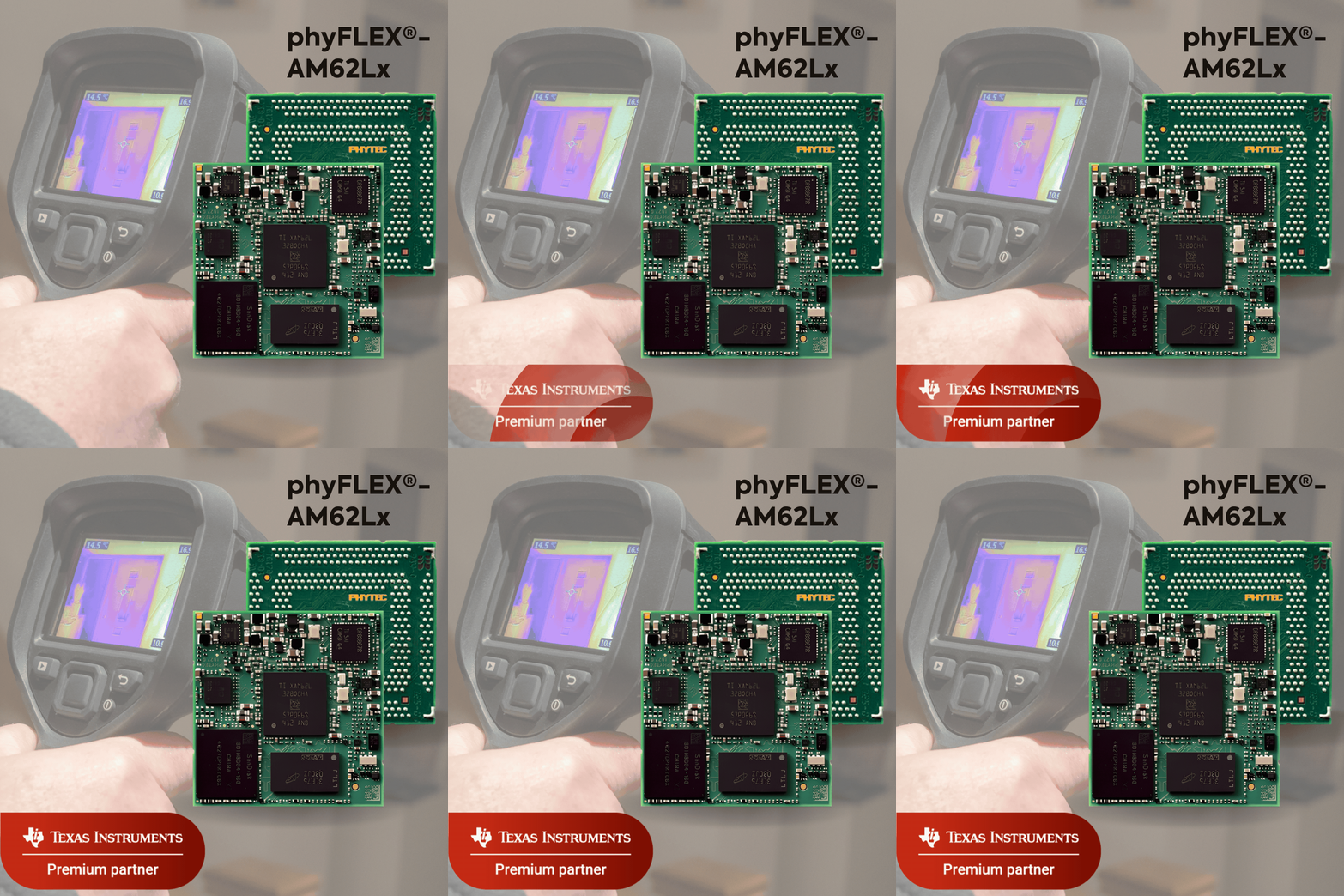
phyFLEX-AM62L
Dual Arm Cortex®-A53 | PHYTEC FPSC form factor | Linux
The AM62L is the place to start when the application needs Linux and a display, but does not need a lot of processor horsepower. With dual Cortex -A53 cores, a single full-HD display, and a focus on low power, it fits embedded products where power, thermals, and cost matter just as much as computing. It is a good match for connected devices, compact HMIs, gateways, and other applications that need a modern Linux platform without paying for performance they will not be able to use.
|
PROCESSING Dual Arm Cortex-A53 with a low-power focus |
DISPLAY / VISION Single full-HD display |
CONTROL / CONNECTIVITY Gigabit Ethernet with TSN |
|
SOFTWARE PHYTEC Linux BSP |
MEMORY Up to 4GB DDR4, Up to 256GB eMMC |
MODULE FORMAT FPSC: 37 x 38 mm (phyFLEX pin compatible) |
Versatile module for a wide range of embedded applications
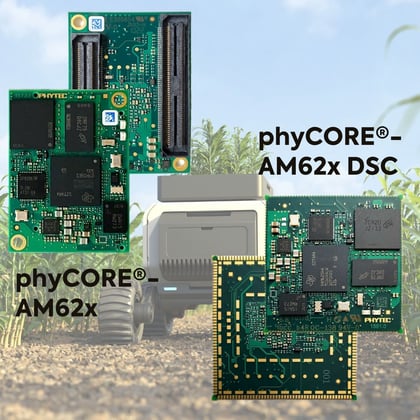
phyCORE-AM62x
Up to quad Arm Cortex-A53 | Arm Cortex-M4F | PRU-ICSS
The AM62x is the general-purpose choice in the family. Up to four Cortex-A53 cores provide Linux application performance, while the integrated real-time capabilities and broad peripheral set make it useful across industrial, commercial, and HMI designs. The biggest reason to choose AM62x is balance: it gives you a capable application processor, graphics, dual-display support, and the flexibility to build a wide range of products without moving into heavier graphics or vision-oriented devices.
|
PROCESSING Up to quad Cortex-A53 plus Cortex-M4F |
DISPLAY / VISION 3D graphics, dual-display support, MIPI CSI |
CONTROL / CONNECTIVITY PRU-ICSS real-time I/O, Ethernet, CAN-FD |
|
SOFTWARE PHYTEC Linux BSP |
MEMORY Up to 4GB DDR4 Up to 128GB eMMC Up to 256MB NOR |
MODULE FORMAT Connector: 43 x 32 mm, 240-pins DSC: 40 x 40 mm, 270-pins |
Performance-optimized platform for advanced HMI and multimedia applications
phyCORE-AM62P & phyFLEX-AM62P:
Two Module Paths
Quad Arm Cortex-A53 up to 1.4 GHz | Arm Cortex-R5F | 3D GPU
Choose AM62P when the product starts to become more about what is happening on the screen. It takes the AM62x foundation and adds significantly stronger graphics and video capabilities, including a 3D GPU, 4K video acceleration, and support for multiple high-definition displays. That makes it a natural fit for industrial HMI, instrumentation, operator panels, and other products where the user interface is a major part of the product rather than an afterthought.
|
Connector based phyCORE | 35 x 50 mm For designs that need broad access to the processor's features and capabilities. |
FPSC direct-solder phyFLEX | 37 x 40 mm For designs that value pin-compatible scalability, with a common FPSC footprint across the phyFLEX family. |
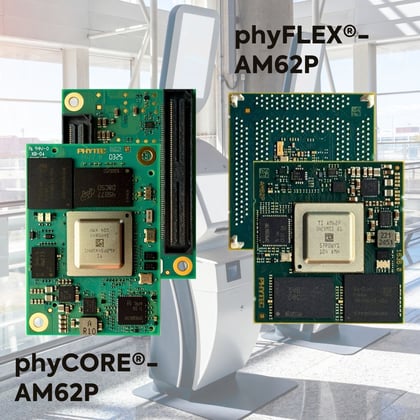
The phyFLEX-AM62P gives you the performance of TI's AM62P processor in PHYTEC's FPSC standard footprint. The important distinction is not just the processor, it is the ability to scale within the phyFLEX family. If your product may need more performance over its lifetime, phyFLEX gives you a path forward without starting the carrier board design over. The phyCORE-AM62P is the better fit when a compact connector based module and broad feature access are the priority.
|
PROCESSING Quad Cortex-A53 up to 1.4 GHz plus Cortex-R5F |
DISPLAY / VISION 3D GPU, 4K video acceleration, multiple displays |
CONTROL / CONNECTIVITY Gigabit Ethernet with TSN, CAN-FD, high-speed I/O |
|
SOFTWARE PHYTEC Linux BSP |
MEMORY Up to 8 GB LPDDR4 Up to 128GB eMMC Up to 64MB NOR |
MODULE FORMAT Connector: phyCORE 35 x 50 mm, 280-pins FPSC: 37 x 40 mm (phyFLEX pin compatible) |
Edge computing module for accelerated machine vision and AI applications
phyCORE-AM62A
Up to quad Arm Cortex-A53 | Arm Cortex-R5F | Integrated vision acceleration
The AM62A is the one to look at when the product needs to understand what a camera is seeing. Instead of relying on the A53 cores alone, AM62A adds dedicated vision and deep-learning acceleration, together with an integrated image signal processor (ISP) designed for camera workloads. That makes it a strong fit for machine vision, robotics, surveillance, and other edge AI applications where the goal is to process sensor data locally instead of sending everything back to the cloud.
.gif?width=420&height=420&name=phyFLEX-AM62Lx%20AD%20Basic%20(1).gif)
|
PROCESSING Up to four Cortex-A53 cores plus Cortex-R5F |
DISPLAY / VISION Integrated ISP, RGB-IR support, MIPI CSI, H.264/H.265 |
CONTROL / CONNECTIVITY Real-time processing and industrial I/O |
|
SOFTWARE PHYTEC Linux BSP |
MEMORY Up to 4GB LPDDR4 Up to 128GB eMMC Up to 256MB NOR |
MODULE FORMAT DSC: 40 x 40 mm, 270-pins |
Other TI Sitara™ modules
Outside the AM62 family, PHYTEC's AM64x and AM67x modules address two very different ends of the design spectrum: deterministic industrial communications and higher-performance vision and AI.
Highly reliable module for industrial automation and real-time control
phyCORE-AM64x
Dual Arm Cortex-A53 | Up to four Cortex-R5F | Cortex-M4F | PRU-ICSSG
The AM64x is the outlier in the AM6 family, and that is exactly why it exists. While the AM62 devices are primarily application processors, AM64x is built around deterministic real-time control and industrial communications. It is also headless, unlike the display-oriented AM62 and AM67 options, it does not include an integrated display subsystem. With Cortex-R5F cores, PRU-ICSSG industrial Ethernet acceleration, and an isolated Cortex-M4F, it is a much better fit for PLCs, motor control, robotics, and factory automation where timing and communications are every bit as important as Linux performance.
|
Industrial Ethernet support: PHYTEC's industrial Ethernet development offering includes EtherCAT SubDevice, PROFINET Device, and EtherNet/IP Adapter demos, with additional engineering support available through PHYTEC partner IBV. |
|
SPI Display support: PHYTEC has solutions for simple display requirements via the SPI interface utilizing the Crystalfontz EVE Capacitive Touchscreen TFT Display. This integrated display can be purchased as an accessory to the development kit when a display is a product requirement. |
|
PROCESSING Dual Cortex-A53, up to four Cortex-R5F, Cortex-M4F |
DISPLAY / VISION *Headless, no integrated display subsystem |
CONTROL / CONNECTIVITY PRU-ICSSG, TSN, EtherCAT, PROFINET, EtherNet/IP |
|
SOFTWARE PHYTEC Linux BSP and industrial Ethernet package |
MEMORY Up to 2GB DDR4 Up to 128GB eMMC Up to 256MB NOR |
MODULE FORMAT Connector: 50 x 37 mm, 280-pins |
High-performance module for advanced machine vision, AI, and real-time edge computing
phyCORE-AM67x
Quad Arm Cortex-A53 | Arm Cortex-R5F | Vision and AI acceleration
Choose the AM67x when the product has moved beyond entry-level edge AI and needs more headroom for advanced machine vision, high-bandwidth sensor processing, and real-time control. The phyCORE-AM67x combines quad Cortex-A53 application processing with a Cortex-R5F real-time core, integrated deep-learning acceleration, an image signal processor, 3D graphics, and high-speed connectivity. It is a strong fit for robotics, medical imaging, factory automation, video analytics, and other camera rich systems that need to process complex data locally.
.gif?width=420&height=420&name=phyFLEX-AM62Lx%20AD%20Basic%20(2).gif)
|
PROCESSING Quad Cortex-A53 plus Cortex-R5F real-time processing |
DISPLAY / VISION Integrated ISP, up to 4 TOPS, 3D GPU, multiple cameras |
CONTROL / CONNECTIVITY PCIe 3.0, USB 3.1, and high-speed sensor I/O |
|
SOFTWARE PHYTEC Linux BSP |
MEMORY Up to 8 GB LPDDR4 Up to 128GB eMMC Up to 256MB NOR |
MODULE FORMAT Connector: 55 x 39 mm, 320-pins |
At-a-glance
PHYTEC AM6 Family SOM Table
The categories below use a common format so the modules can be compared by workload, processing, display or vision capability, control and connectivity, software, and physical integration.
|
PHYTEC SOM |
Best fit |
Processing |
Display / vision |
Control / connectivity |
Software and format |
|
Low-power Linux devices, compact HMIs, gateways |
Dual Cortex-A53; low-power focus |
Single full-HD display |
Gigabit Ethernet with TSN |
PHYTEC Linux BSP; 37 x 38 mm FPSC |
|
|
General embedded Linux, HMI, connected control |
Up to quad Cortex-A53; Cortex-M4F |
3D graphics; dual display; MIPI CSI |
PRU-ICSS real-time I/O; Ethernet; CAN-FD |
PHYTEC Linux BSP; 43 x 32 mm connector or 40 x 40 mm DSC |
|
|
Advanced HMI, instrumentation, multimedia |
Quad Cortex-A53 up to 1.4 GHz; Cortex-R5F |
3D GPU; 4K video; multiple displays |
Gigabit Ethernet with TSN; CAN-FD; high-speed I/O |
PHYTEC Linux BSP; 35 x 50 mm connector |
|
|
Advanced HMI with a scalable footprint path |
Quad Cortex-A53 up to 1.4 GHz; Cortex-R5F |
3D GPU; 4K video; multiple displays |
Gigabit Ethernet; CAN-FD |
PHYTEC Linux BSP; 37 x 40 mm FPSC |
|
|
Camera-centric machine vision and edge AI |
Up to quad Cortex-A53; Cortex-R5F |
Integrated ISP; RGB-IR; MIPI CSI; H.264/H.265 |
Real-time processing and industrial I/O |
PHYTEC Linux BSP; 40 x 40 mm DSC |
|
|
Headless real-time control and industrial Ethernet |
Dual Cortex-A53; up to four Cortex-R5F; Cortex-M4F |
*Headless - no integrated display subsystem
*SPI display support |
PRU-ICSSG; TSN; EtherCAT; PROFINET; EtherNet/IP
Industrial Ethernet package by IBV |
PHYTEC Linux BSP; 50 x 37 mm connector |
|
|
High-performance machine vision, AI, and edge compute |
Quad Cortex-A53; Cortex-R5F |
Integrated ISP; up to 4 TOPS; 3D GPU; multi-camera |
PCIe 3.0; USB 3.1; real-time processing |
PHYTEC Linux BSP; 55 x 39 mm connector |
Configuration options vary by processor and module revision. Confirm final memory, interface, temperature, and software requirements against the current PHYTEC product documentation before design freeze.
Which PHYTEC SOM is right for you?
There is no single 'best' PHYTEC AM6 SOM. The right choice depends on the workload, display and vision requirements, real-time needs, carrier-board strategy, and how much performance headroom the product needs over its lifetime.
-
Choose phyFLEX-AM62L when low power, cost, and a scalable FPSC footprint path come first.
-
Choose phyCORE-AM62x for a balanced Linux platform with graphics, broad connectivity, and real-time I/O.
-
Choose phyCORE-AM62P or phyFLEX-AM62P when graphics, multiple displays, and video define the product experience; choose the module format that best matches the footprint and feature strategy for your application.
-
Choose phyCORE-AM62A for camera-centric edge AI with an integrated ISP.
-
Choose phyCORE-AM64x for headless deterministic control and industrial Ethernet.
-
Choose phyCORE-AM67x when advanced vision and AI need more processing headroom and high-speed I/O.
What PHYTEC Adds
|
HARDWARE Production ready SOM hardware and development kits for evaluation. |
SOFTWARE Linux BSPs and the documentation needed to begin development. |
DESIGN TO PRODUCTION Copy our carrier board circuits, free engineering support, and a practical path from evaluation to production. |