When PHYTEC engineers look at a circuit board, they don't just see components. They see decades of evolution. 40 years in the embedded industry has given PHYTEC a unique vantage point: capacitors that once felt like bricks have shrunk to grains of sand, resistors have become nearly microscopic, and processors have evolved far beyond what anyone imagined decades ago.Through it all, PHYTEC has been guided with a single mission - give developers the flexibility and control they need to build embedded systems that last.
- Every signal from the processor is available
- No artificial pinout constraints
- Maximum customization of the carrier board
- Full access to interfaces, features, and performance
Choosing the Right SOM
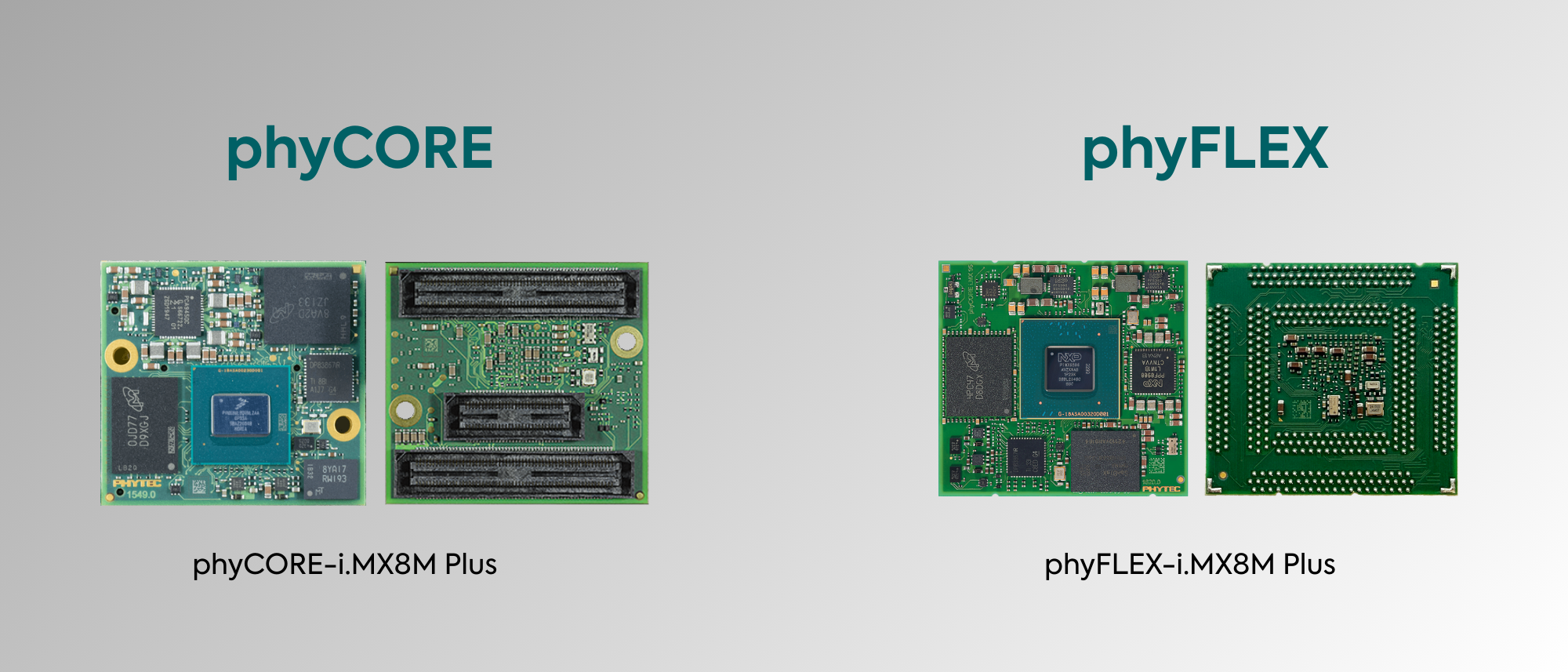
When deciding between our more traditional phyCORE modules or phyFLEX modules, customers can pick the trade-offs that matter to them:
- phyCORE for full access to all processor features without pin compatibility requirements.
- phyFLEX for platform longevity and modularity. Because of its carefully structured pinout, upgrading to future SOMs is possible even without redesigning the carrier board.
Our custom API abstracts away the complexity of working with different silicon vendors and our pre-built BSPs enable software application development in its most efficient form. Yocto meta-layers and an SDK enable customers to build applications without needing to modify kernel, bootloader, or core BSP components. This saves significant time and cost compared to a ground-up software bring up effort.
Whether you choose phyCORE or phyFLEX, PHYTEC provides the software support, compliance guidance, and lifecycle services needed to maintain high performance and reliability over the entire product lifespan.
phyFLEX for the Future
Embedded systems are inherently complex, and design cycles often outlive the hardware they’re built on. Standards can extend a design’s lifetime and reduce costs, but without flexibility, even the most scalable system can fall short. PHYTEC's early attempts at interchangeable SOMs in the mid-2000s showed promise, but constraints of connectors in terms of pinout, size and cost limitations made full flexibility difficult. Today, with FPSC and phyFLEX, PHYTEC offers a solution that delivers maximum customization, long-term investment security, and seamless upgrade paths, all informed by decades of real-world embedded experience.
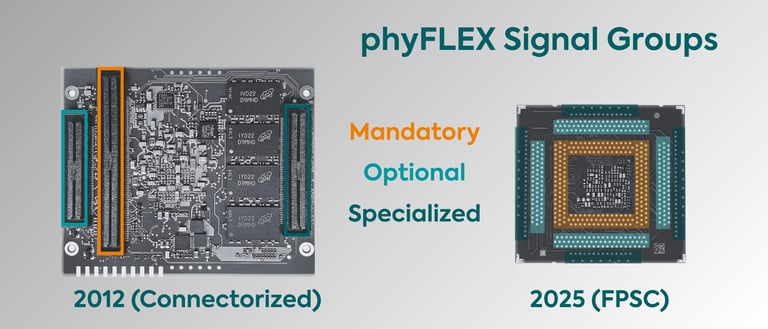
We had the idea of making modules interchangeable 15 years ago. Ultimately, the idea is even older as back then there were phyCARD modules, which were 100 percent pin-compatible. However, they only had one connector which didn't support all the processor's functionalities. The phyFLEX SOMs [of the past] had three connectors, comparable to today's signal categories: Mandatory signals, Optional signals, and Specialized signals. However, back then, the large and expensive connectors with their limited number of pins were a significant constraint in terms of both price and space. - Bodo Huber, PHYTEC CTO
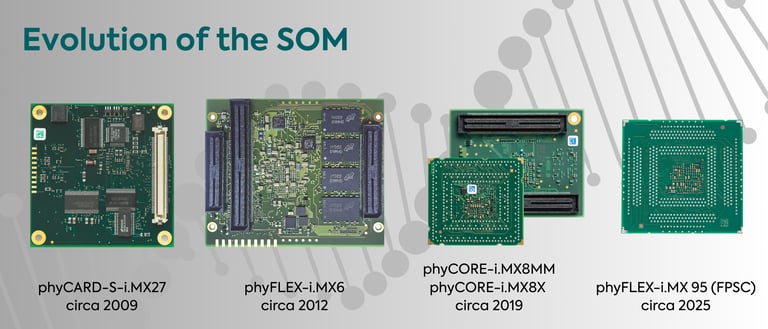
Thanks to the developments in soldering technology and 40 years of experience in embedded design, manufacturing and problem solving, PHYTEC has developed a solution that wisely balances both the needs of embedded developers with the requirements of standardization. Our newly re-introduced product line, phyFLEX built with FPSC technology enables a high percentage pin compatibility across a full line of modules.
phyFLEX: Mitigate Risk with FPSC
phyFLEX is a product line of interchangeable SOMs that features the FPSC standard footprint technology. FPSC enables a modular hardware solution to diversify component sourcing, manage lifecycle, and maintain flexibility. phyFLEX helps customers be resilient and ready to adapt with:
- Evolving Technology Trends
- Supply Chain Constraints
- Component Allocation
The pinout of FPSC is thoughtfully organized into three categories:
- Mandatory signals — the foundational features every module needs for baseline functionality and maximum interoperability providing 100% compatibility up and down the phyFLEX product line.
- Optional signals — common interfaces used in many applications today that will likely remain relevant in future chip generations, providing standardization to pin position.
- Specialized signals — interfaces reserved for advanced or unique features of certain processor families with no guaranteed standardization.
This layered structure gives embedded developers the flexibility to use only the mandatory signals for maximum interchangeability or to tap into optional and specialized ones when you need advanced features. This way, you can upgrade to future SOMs without redesigning your carrier board or maintain tight optimization when size and cost matter.
Designed with Revisions In Mind
The phyFLEX product line delivers a standard footprint while maintaining PHYTEC’s core values of customization, locked BOMs, and flexible pinouts to meet unique use cases.
- No Vendor Lock (Silicon, Memory)
- Cost Savings (BOM change of the SOM, not a design spin)
- 625 pads max (32% Ground)
- Flexible SOM sizes: Max 53x50 mm | Min 37x40 mm
- Specialized Signals available for customization when pin-compatibility is less important
FPSC Stands Apart from Open Standards
Embedded devices bring together many moving parts. Selection of essential features, product variations and technology shifts can cause expensive end of life scenarios for products on the market. Limitations in the basic design mean limitations for the end product. FPSC reduces design complexity without limiting development with an organization of signals for maximum flexibility in embedded design with options to customize, giving the power of design back to the engineer.
Open standards such as Qseven, SMARC, and OSM have limitations for high-performance ARM-based embedded designs:
- Qseven is outdated, with limited signals and connectors, making it unsuitable for modern ARM processors.
- SMARC guarantees 30 signals (not including power and ground) but requires large form factors and additional connectors for non-standard interfaces, echoing early limitations of phyFLEX’s first SOMs.
- OSM guarantees up to 12 signals in the largest size module (not including power or ground) and relies on Land Grid Array (LGA) soldering and provides fewer guarantees for mechanical and thermal reliability.
In contrast, PHYTEC’s FPSC technology addresses these issues directly:
- More Guaranteed Interfaces Available
- 73 Mandatory signal pins (not including power and ground)
- 42% pin compatibility
- Targeted feature sets provide predictable compatibility across highly complex processors
- Optional customization.
- FTGA soldering ensures better coplanarity, higher mechanical load capacity, and more reliable joints than LGA-based standards.
- Mechanical coupling of the SOM to the carrier board with Solder Anchor Joints improves durability.
- Tested for shock and vibration resistance for industrial, military, and automotive applications according to EN 60068-2.
- Rework and underfill capabilities allow two-sided penetration and precise placement of block and bypass capacitors, optimizing EMC behavior and error immunity.
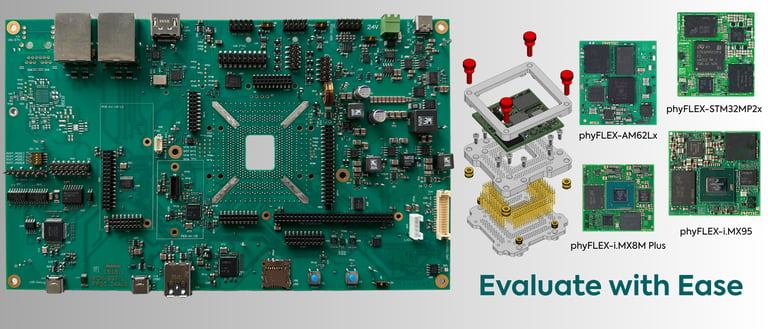
- SOM Socket for evaluation and debug: drop in any FPSC SOM without the need for solder reflow.
phyFLEX with FPSC Technology is a Future Proof Solution
By managing the SOM, the BSP and the integration process, PHYTEC ensures that every layer of the system works together seamlessly. phyFLEX means interchangeability without compromise: Our technology is the result of decades of experience with soldering modules, optimizing process technology, designing solder joints and holding points, combined with the experience gained from hundreds of thousands of modules in the field. Our compatibility guarantee ensures minimal effort when changing modules.
If you're working on a project that needs long-term embedded stability and future scalability, phyFLEX is well worth a look. Contact our sales team to learn more about phyFLEX SOMs, FPSC technology or explore our phyCORE family of products to find the right module for your application.
.png?width=1200&height=800&name=-Vorlage-%20Webinar%20Linkedin%20%26%20Youtube(1).png)
Ready to See What's Next?
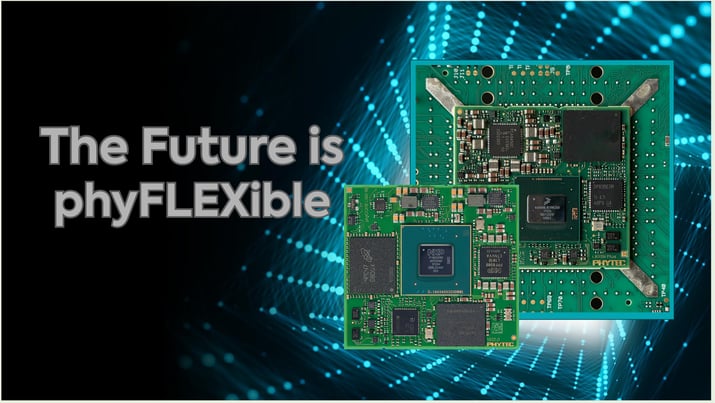
If you want to dive even deeper into FPSC, phyFLEX, and the future of modular embedded design, check out our webinar: The Future is phyFLEXible

.png?width=600&height=315&name=Hubspot%20blog%20image%20banner%20(1).png)